
Adapnia® · Burley Performance Labs Ltd
Prime before you train. Perform better under fatigue.
Prime. Adapt. Perform.
A published breath-hold protocol that lifts your blood’s oxygen-carrying capacity in a single session — and, repeated for three weeks, made our study group measurably faster over three miles. Dry, lying down, forty minutes. No hyperventilation at any point.
For athletes chasing a time, a standard or a selection. If you are after breathwork, relaxation or wellness, this is not that.
Where it started
It began as one observation.
“I started freediving in 2010. Training time was short, so I designed breath-hold sessions to produce adaptation on a compressed timescale, applying the progressive overload principles I already used in military conditioning. They improved my breath-hold, as intended. What I did not expect was that my running and general aerobic fitness climbed during those same blocks, with no change to my endurance training.”
Matt Burley, founder. That observation became a research question, and the question became a PhD at the University of Exeter. The two published results below are what the research found. More about the founder →
The evidence
Two published results.
The result first, then the number most people leave out. Three weeks of breath-hold training made our study group measurably faster over three miles, and a single priming session lifted time-trial work by 8.2%. Those are real, published results, in named journals, with the DOIs on this page.
Study A · one session · 11 healthy men
8.2% more work in the time trial.
Work done in the five-minute time trial
After forty minutes of quiet rest
After the breath-hold session
The difference: 8.2% more work (p = 0.019)
Study B · three weeks · 48 US Marine Corps officer candidates
The breath-hold group improved about two percentage points more.
Improvement in three-mile run time
Control group: training only
Breath-hold group: the same training, plus the protocol
The gap: about two percentage points (p = 0.02)
Now the part most of this industry leaves out. The control group improved too — 4.9% doing the same training — so the gain you can attribute to breath-hold work is the gap between them, roughly two percentage points. We lead with that number because it is the honest one, and because you can check it yourself in the paper.
Named author, named journal, DOI. Tested in healthy men and male military personnel, with published results in both — read them yourself.
Burley, M. et al. Physiological Reports, 2026. The performance paper. DOI: 10.14814/phy2.71056 →
Burley, M. et al. Experimental Physiology, 2022. The mechanism paper. DOI: 10.1113/EP090531 →
What the studies actually found — including what they don’t show →
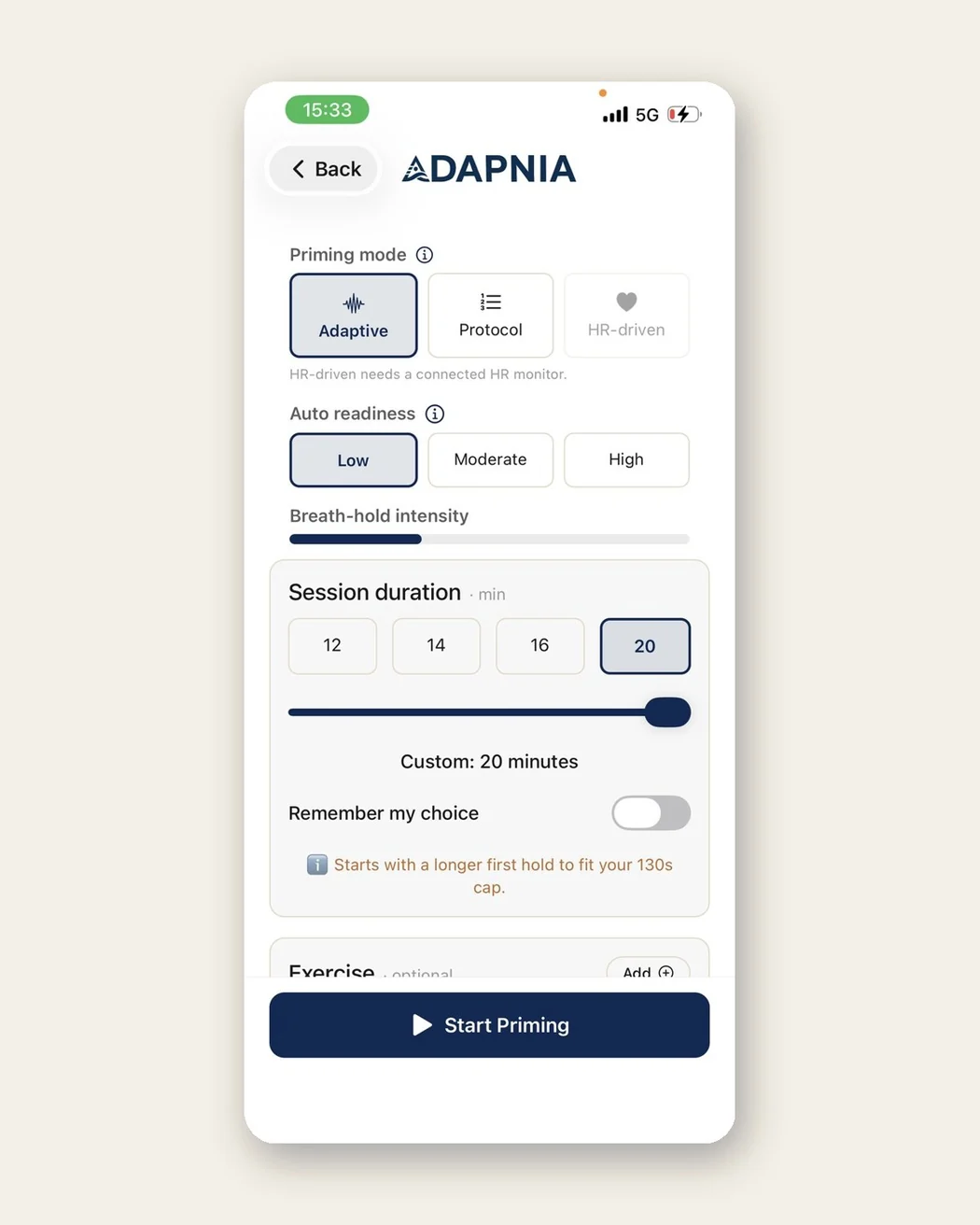
How it works — Priming
Prime before you perform.
Priming is the reason Adapnia exists. A guided breath-hold session run immediately before training or competition that primes your blood's oxygen-carrying capacity — so you start the session primed, not warming into it.
- Lie down, somewhere dry. At the track, in the gym, or in the changing room before you go.
- Follow the voice. The app leads you through a ladder of breath-holds, each a little longer than the last, with ordinary breathing in between. No hyperventilation at any point.
- Then train. Get up and go straight into the session you came to do. In the study, exercise began two minutes after the session ended.
It runs in three modes — Adaptive, Protocol and HR-driven — so it fits any athlete and any setting. See how each mode works →
The published results belong to the full session: fifteen holds, about forty minutes. Shorter sessions in the app are built on the same protocol.
And you learn the method, not just the app. The protocol is published, and the curriculum teaches the reasoning behind it — so you can build and run your own sessions rather than depending on us to hand them to you.
The published protocol is free in the app, in full. Pre-Exercise Priming is part of Adapnia Pro. UK Patent Application No. 2616190.1 — patent pending.
See priming in the appBefore you go further
Is this worth your time?
It depends on what you are training for.
Worth it
You are chasing a time or a standard.
A qualifying time, a selection standard, a personal best you have stalled on. Two percentage points is the margin between making it and missing it — and you are already doing everything else right.
Worth it
Your sport is hard effort under fatigue.
Combat sports, team sports, tactical and first-responder work. Start with priming rather than the training block: it is one session, not fifteen, and it costs you forty minutes before you train.
Worth it
You want a longer breath-hold.
Freedivers and swimmers. Here breath-hold duration is the outcome itself rather than a proxy for something else, and it was the largest change measured in the study.
Probably not
Take the priming only.
If you are training for general health rather than chasing a number, the acute effect still works from the first session. But forty minutes, five evenings a week, for a couple of percentage points is a lot of life to spend when you are not racing anyone. Take the priming. Leave the block to the people who need the margin.
The work behind it
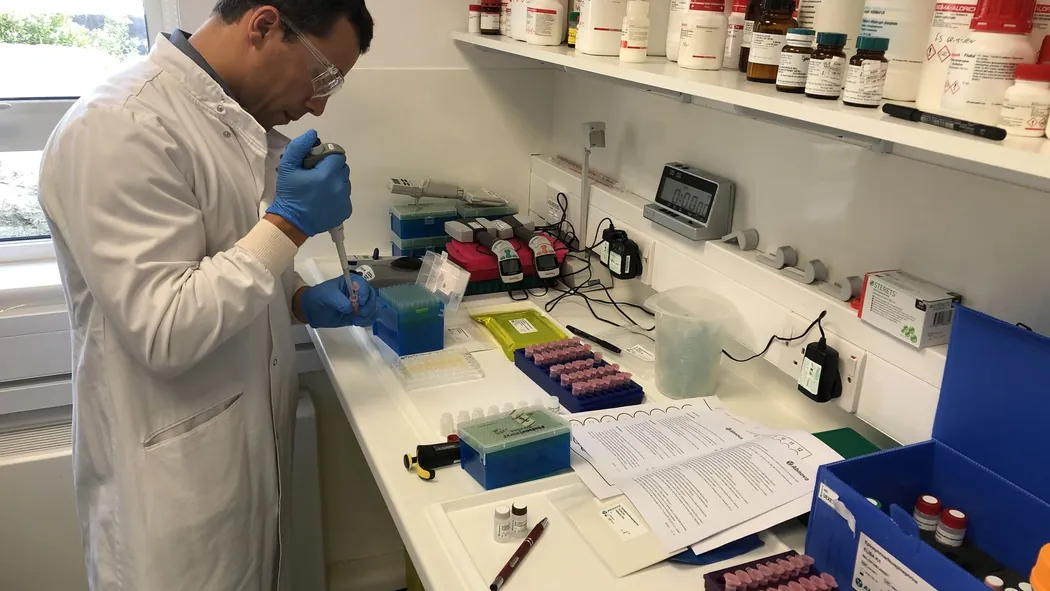
Built by a researcher who teaches and trains.
Adapnia is led by Matt Burley, a performance physiology PhD researcher at the University of Exeter and a Royal Navy officer. He has run physical training at scale — including as Senior Physical Training Advisor at the United States Marine Corps Officer Candidates School in Quantico — and has lectured to audiences ranging from the Physiological Society to S&C and freedive communities internationally.
The brand exists because there is a gap between what the breath-hold literature actually supports and what the breathwork market sells. Adapnia closes that gap — with named authors, reproducible methods, and zero medical claims.
More about the founderFour ways to train
The same evidence, four delivery formats.
Choose the format that fits your environment — from self-paced training in the app to bespoke in-person delivery for your team.
The App
Audio-first, offline-first breath-hold and conditioning training. Designed for fatigue.
Explore the app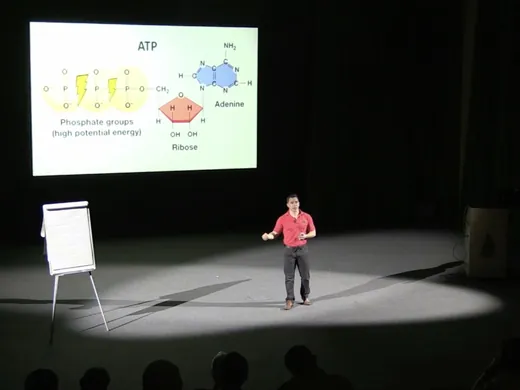
Webinars
Live, research-led 90-minute sessions on Microsoft Teams. £25 a seat, with the recording included.
Explore the webinars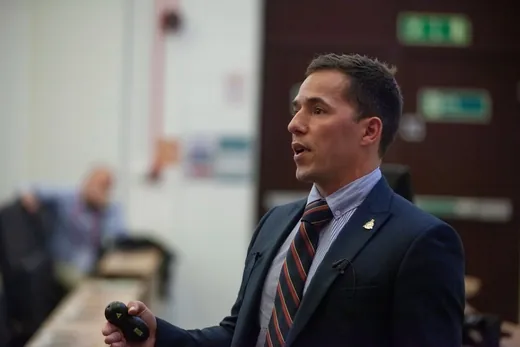
Seminars
In-person delivery for clubs, teams, fire services and corporate audiences.
Bring Adapnia to your teamCoaching
One-to-one and small-group coaching at your venue. Dry, controlled, supervised.
Explore coachingResponsible for other people’s training? We also teach a four-stage method for building breath-hold conditioning into your organisation’s own training system. See how it runs →
Stay close
Get early access and quarterly research notes.
No spam. No medical claims. Updates when there's something to share.
By signing up you agree to our Privacy Policy.